In a warehouse or logistics environment you see them moving around side by side: forklifts, reach trucks, electric pallet trucks. To an outsider they look like variations on the same thing, but each of these machines is designed for a specific task. Using the wrong machine for the wrong job isn't just inefficient — it can also be dangerous. In this article we explain what the differences are and in which situation you use which machine.
The forklift: the powerhouse
The forklift is the best known of the bunch and also the most robust. Its key feature is the heavy counterweight at the rear, which keeps the truck stable while it lifts a load at the front. That makes it suitable for heavier loads and, depending on the type, for outdoor use on a paved surface as well.
A forklift is in its element where there's room to manoeuvre and where loads need to be taken from a lorry or out of storage and moved. Think of loading and unloading areas, outdoor yards and warehouses with wider aisles. What it can't do well is work in narrow aisles or stack at great height — for that it's simply too wide and not built for the job.
The reach truck: the specialist for height
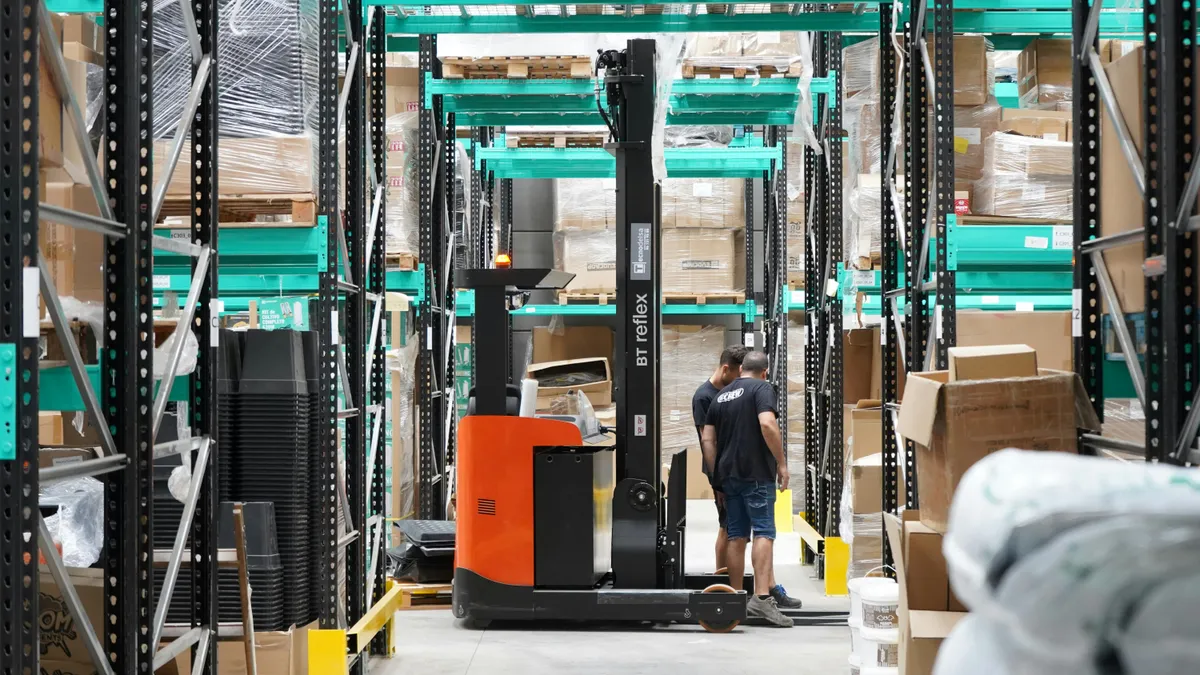
Where the forklift is wide and powerful, the reach truck is slim and precise. It has no large counterweight but achieves its stability through the design of the chassis and the fact that the mast can be fully retracted. Its unique quality is in the name: the mast can "reach" forward to pick up a pallet, then draws back in compactly.
That makes the reach truck ideal for the modern warehouse with high racking and narrow aisles, where every square metre of space counts. It can stack considerably higher than a forklift and fits into aisles where a forklift could never turn. The downside is that it demands more of the operator. At height, with the mast extended, the centre of gravity shifts significantly and the truck becomes more prone to tipping. Operating a reach truck without the right knowledge is therefore a real risk.
The electric pallet truck (EPT): the agile worker
The electric pallet truck is the simplest of the three, but no less important for it. It's intended for horizontal transport — moving pallets across the floor, over shorter or longer distances. It doesn't lift high, but just enough to get a pallet clear of the ground and move it.
The EPT is at its best in environments where many pallets need to be moved over short distances: loading and unloading, replenishing stock, moving goods between different zones. There are various versions, from pedestrian models to types with a ride-on platform or even a seat for longer distances. Which one you need depends on the distance, the frequency and the weight you're moving.
How do you choose the right machine?
The question isn't really which machine is the best, but which one suits the work that needs doing. A few rules of thumb help here.
Do you mainly work with heavier loads, on an outdoor yard or in a space with wide aisles? Then a forklift is probably the right choice. Do you have a warehouse with high racking and narrow aisles where every metre counts? Then the reach truck is indispensable. Do you mainly move pallets across the floor without needing to stack high? Then an EPT is the most practical and efficient solution.
In practice, many companies need a combination. A logistics centre often uses forklifts at the loading docks, reach trucks in the warehouse aisles, and EPTs for the internal transport in between. It's then important that employees can not only drive, but also understand which machine is intended for which task — and where the limits lie.
The right equipment and the right knowledge
A common mistake is to assume that someone who can drive a forklift can automatically operate a reach truck or EPT safely too. That's not the case. Each type calls for its own driving style, its own understanding of stability and its own points of attention. A reach truck operated as if it were a forklift, or an EPT used on the wrong surface, creates situations that occur daily and that are avoidable.
At HefPro we train for all types of internal transport equipment, and we do so on-site — with the machines your employees actually use. That way they learn not only to drive, but also to understand which equipment they're using and why the right choice matters.
Want to know which training suits your team and your equipment? Get in touch via info@hefpro.nl or +31 6 15 37 48 10. We're happy to think along with you.