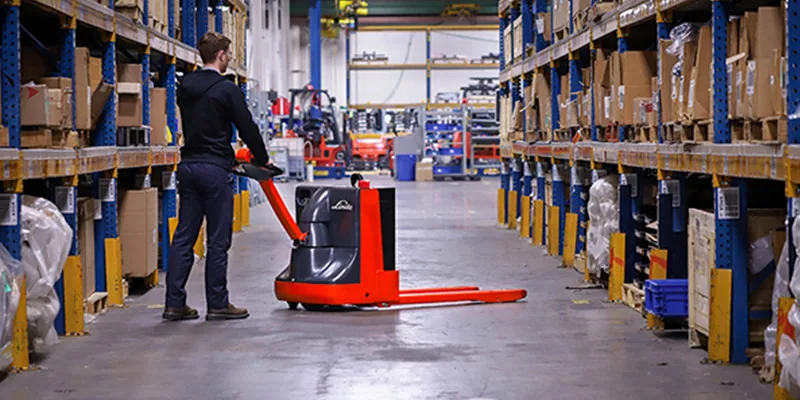
In our series on internal transport equipment, we've already looked at the forklift, the reach truck and the electric pallet truck. But there's another machine you'll come across in many warehouses that often falls a little between the cracks: the stacker. It's used a lot, particularly by employees who don't have a full forklift qualification, and as a result its risks are sometimes underestimated. Time to take a proper look at it.
The machine that sits between the pallet truck and the forklift
The stacker is easiest to understand as an in-between form. In terms of function, it sits exactly between the electric pallet truck and the forklift. Like a pallet truck, it moves pallets across the floor, but unlike the pallet truck it can also genuinely stack — placing goods up high. At the same time, it doesn't match the reach and lifting capacity of a forklift. It lifts less high and less heavy.
That makes it ideal for a specific kind of work: stacking lighter loads over shorter distances and at a lower level. Where a forklift is too big or too heavy and a pallet truck doesn't reach high enough, the stacker is often just right.
Different versions
Just like the other machines, the stacker comes in several variants, each with its own application. There are pedestrian stackers, where the operator walks alongside. There are ride-on stackers and stackers with a seat, for those covering greater distances. And there are versions with a fold-down platform, a handy in-between solution. Which one you need depends on the distance you cover, the frequency and the space you work in.
Stability: the strength and the limitation
An interesting feature of the stacker is where the load sits. It's close to the centre of the machine, and that's good for stability. In that respect, the stacker is an agile and relatively manageable machine to work with.
But there's a flip side. At greater heights a stacker is less stable than a forklift, simply because it isn't built for that. The limited lifting capacity isn't an accidental trait but a design choice, and crossing that limit — by lifting too heavy or reaching too high — is exactly where things go wrong. A stacker is safe as long as you use it for what it's intended.
Why instruction is essential here too
This is perhaps the biggest risk of the stacker, and it has nothing to do with the machine itself. Because a stacker looks simple and is often used by employees without a full forklift qualification, the idea arises that you can work with it without instruction. After all, it's easy to operate. And that's true — up to a point.
But an unstable load, a wrongly placed pallet or a stacker used beyond its limits can lead to serious accidents just as easily as any other machine. Falling goods, a tipping load, a collision: it happens with stackers too. The fact that a machine is easy to operate doesn't mean it's safe to use without knowledge. Precisely because the threshold seems low, good instruction is extra important here.
What do you learn at HefPro?
At HefPro we provide training for the stacker, just as we do for the other internal transport equipment. We teach operators not only the handling, but above all the insight: what this machine can and can't do, where the limits lie, and how to recognise a situation that becomes unsafe. Because we train on-site, we do so with the stackers your people actually use, in the space where they work with them.
That way you ensure that even the employees who use the stacker "just quickly" do so safely and consciously. Want to know what stacker training for your team involves? Get in touch via info@hefpro.nl or +31 6 15 37 48 10. We're happy to think along with you.