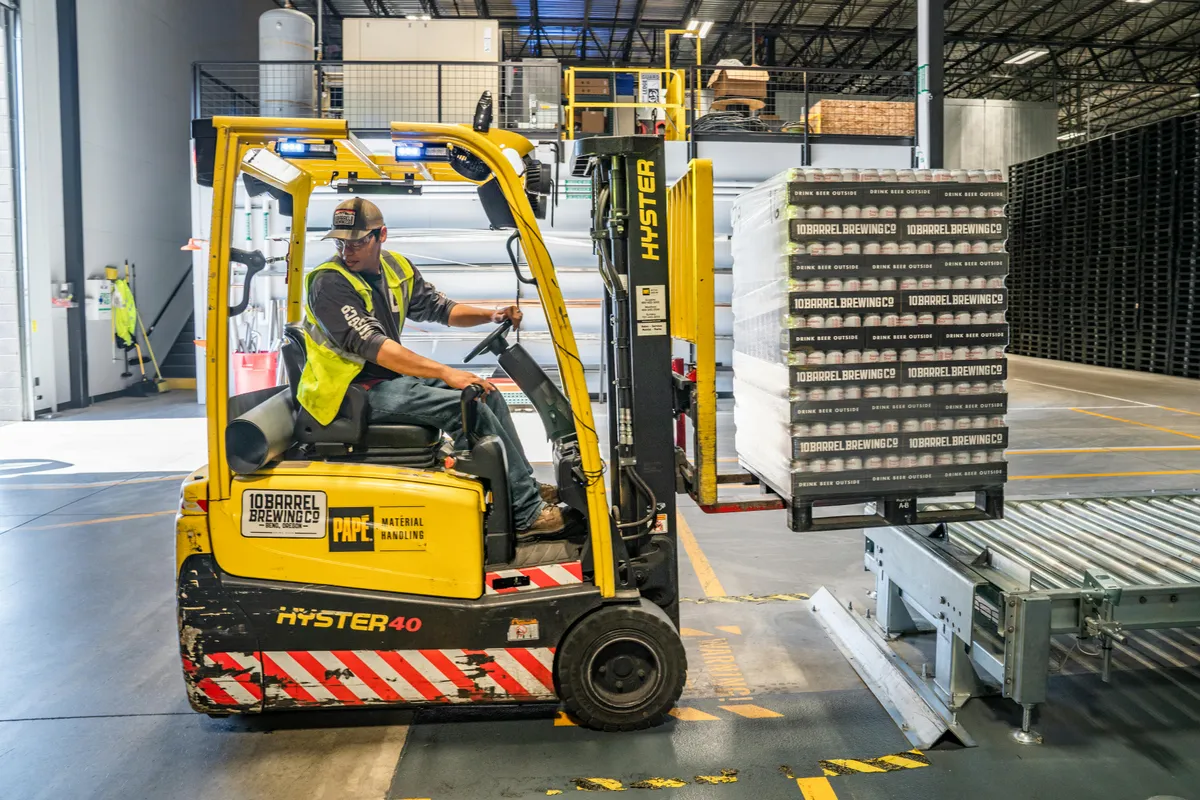
Hundreds of forklift incidents occur every year across the logistics sector. Employees sustain injuries, goods are damaged, and operations grind to a halt. And in most cases, the cause is not a faulty machine — it's human behaviour: driving too fast, misjudging a situation, a moment of inattention. Knowledge and awareness are by far the most effective protective factors. Here are five safety rules that every forklift operator must know — and apply.
1. Understand the stability triangle
A forklift does not run on four wheels like a car. It rests on three support points: the left front wheel, the right front wheel, and the pivot point of the rear axle. Connect those three points with an imaginary line and you have the stability triangle. As long as the combined centre of gravity of the truck and the load stays within that triangle, the machine is stable. The moment that centre of gravity shifts outside — through a sharp turn, an oversized load, an uneven surface, or excessive speed — the truck tips. And that happens in fractions of a second, without warning.
What many operators fail to appreciate is how strongly the centre of gravity is affected by small actions. A load raised just slightly too high. A bend taken just a fraction too fast. A floor with an unexpected ridge. An operator who understands the stability triangle makes better decisions — even under time pressure.
2. Adapt your driving to the situation
A forklift is not a car. It responds differently, brakes differently, turns differently. Yet on the work floor we regularly see driving behaviour that fails to account for those characteristics: too fast through a bend, braking too late before an intersection, not enough clearance near racking.
Health and safety law is clear about the operator's responsibility: you determine how safely the machine is used. That means always slowing to a walking pace at intersections, giving way to pedestrians, and adjusting speed to the load being carried.
3. Never leave the truck without doing these three things
Leaving the forklift — even just for a moment? Forks to the floor, engine off, key out. Always. Without exception. A truck left unattended with the key in and the forks raised is a danger to everyone in the vicinity.
It sounds simple, but the routine moments are precisely the most dangerous ones — because autopilot takes over and conscious attention disappears.
4. Know the risk zones in your warehouse
Not every part of the warehouse carries the same risk. The places where things most often go wrong are intersections where trucks approach from multiple directions, the area around racking, loading and unloading bays where different people converge in one place, and ramps and dock levellers where the risk of tipping is higher.
A good operator knows their environment and actively adapts their driving to those risk zones — even on a route they've driven a hundred times before.
5. Always report unsafe situations
A safe workplace doesn't mean nothing ever goes wrong. It means everyone knows what to do when it does. Defective trucks, damaged racking, oil leaks, broken pallets, a slippery floor — these are all situations that must be reported immediately.
As a forklift operator, you are legally obliged to report unsafe situations and to stop work if the danger is too great. That's not weakness. That's exactly what working safely means.