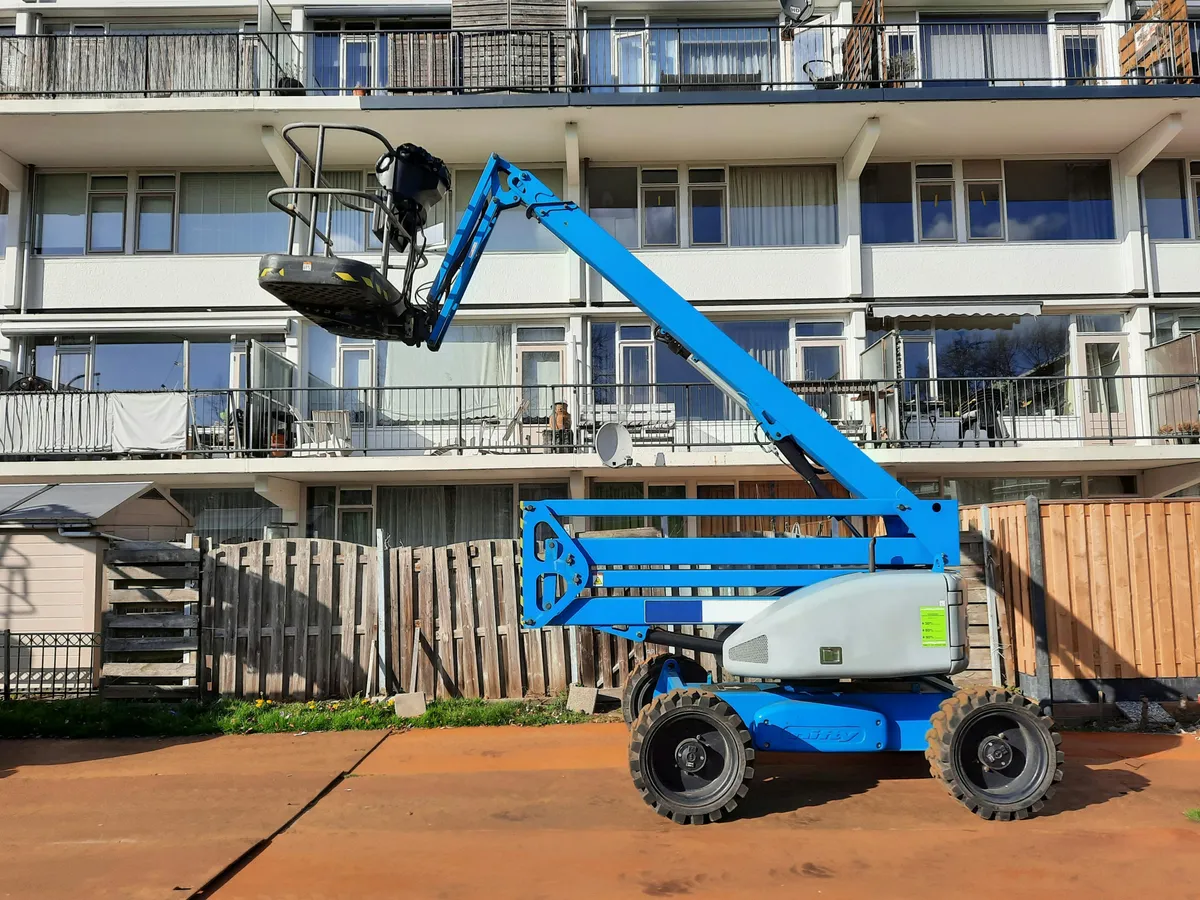
Anyone who has worked with an aerial work platform knows how routine it starts to feel after a few times up. You press a button, the platform rises, you get the job done, and you come back down. Simple. But that very sense of familiarity is exactly where things go wrong. Most AWP incidents are not caused by technical failure — they result from small mistakes that compound, often made by people who know perfectly well how to operate the machine but underestimate the situation around it.
These are the five mistakes we encounter most often.
1. Not checking the ground surface before going up
This is by far the most common mistake. An AWP is heavy, and once the boom extends, the centre of gravity shifts significantly. On a hard, flat concrete floor that's not a problem. But a soft surface, a manhole cover, a slope, or a floor that looks solid but isn't — these are all situations that must be assessed before you move.
The problem is that people make this assessment while they're already in the machine, or worse, while they're already airborne. By then the information is useless. Assessing the ground belongs to preparation, not to execution.
2. Not deploying the outriggers — or not deploying them correctly
AWPs fitted with outriggers are sometimes used without them fully extended, either to save time or because space is tight. But outriggers are not decorative. They enlarge the machine's footprint and ensure the centre of gravity stays within safe limits when the boom is extended. Partially deployed outriggers provide only a fraction of the stability the machine actually needs.
This is a mistake that isn't always immediately apparent, but in the wrong combination of factors — a slight incline, a gust of wind, an uneven surface — it suddenly becomes very visible.
3. Leaning too far over the edge of the platform
The platform of an AWP is the size it is for a reason. The operator is supposed to work within the platform's dimensions. Yet we regularly see people leaning over the edge to reach just a bit further — a light that's just out of reach, a bolt that's just not quite accessible, an angle that's just a bit further away.
The risk is twofold. First, body weight shifts outside the platform, which affects balance. Second — and this is underestimated — the chance of falling from a sudden movement of the machine or a stumble becomes very real. A fall restraint helps, but doesn't prevent everything.
4. Working in wind without assessing the conditions
AWPs have a maximum wind speed at which they may safely be used. That limit is stated in the machine's manual and exists for good reason. Wind at height is stronger than wind at ground level, and an extended boom acts like a sail. Yet people regularly keep working when conditions are actually too windy, simply because it seems manageable on the ground or because there is time pressure.
This is a grey area in practice — wind is rarely constant and there isn't always an anemometer nearby. But the rule of thumb is: if you notice the platform moving due to wind, it's too late to assess whether it's safe. At that point, you stop.
5. Assuming the machine is fine because it was fine yesterday
A daily pre-use inspection is mandatory for many machines, and AWPs are no exception. Hydraulics, brakes, outriggers, safety harness anchor points, emergency stop — these are components that are used every day and must be checked every day.
In practice, that check is skipped because the machine worked yesterday, because there's a rush, or because nobody has clearly explained what that check should actually look like. A defect that would have been visible in the morning becomes an incident in the afternoon.
Working safely at height is not complicated, but it does require awareness and the right habits. At HefPro, we teach operators not just how to operate an AWP, but how to assess the situation before they go up. Because most mistakes are not made in the air — they are made on the ground, in the minutes before departure.