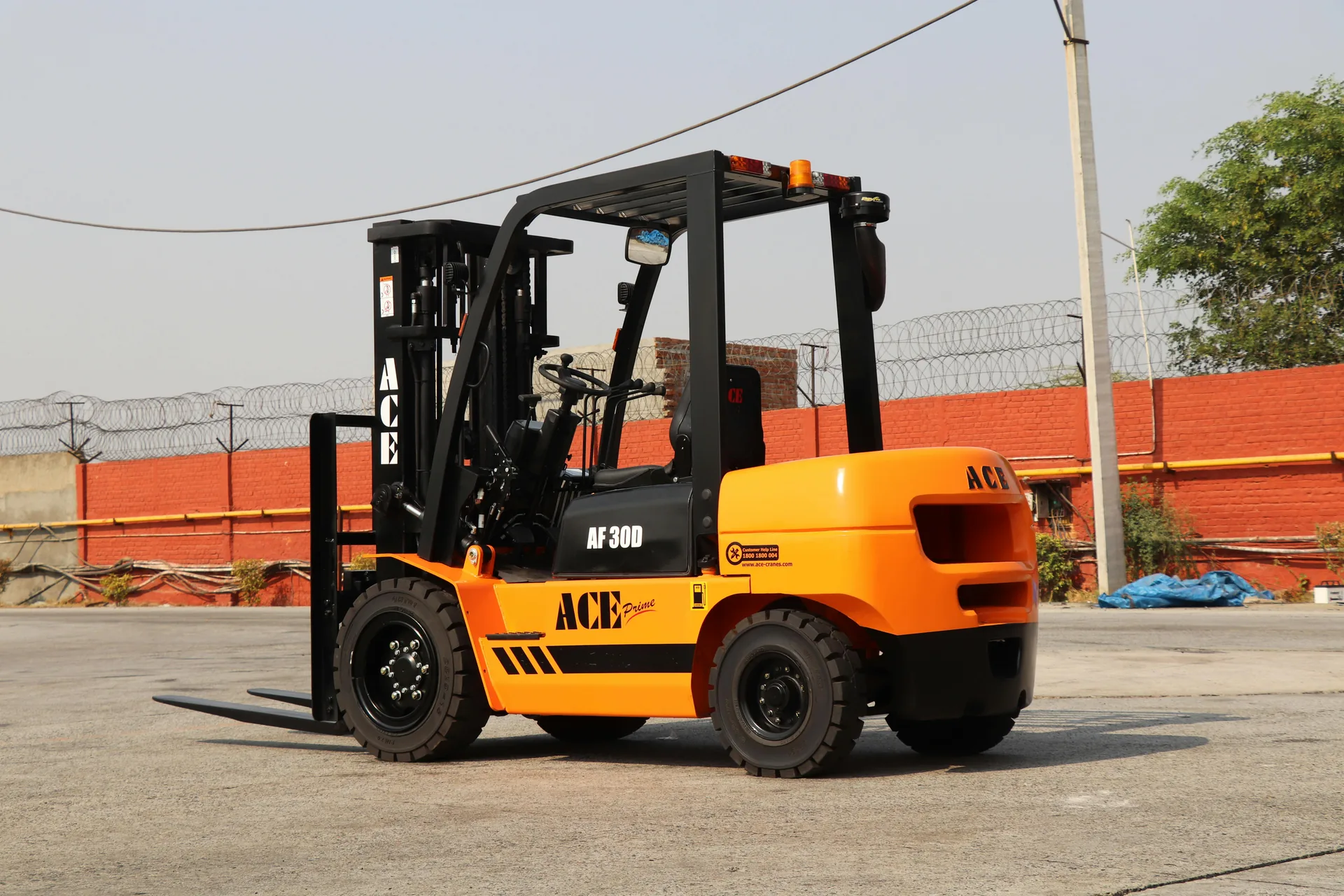
Not every forklift is electric. In many companies, trucks still run on diesel or LPG — and often for good reason: they're powerful, flexible and suited to heavy work. But the moment such a combustion engine is used indoors, in a hall, warehouse or other enclosed space, a risk arises that you can't see, can't always smell, and that is dangerous precisely because of that. In this article we look at what's at play and how to handle it sensibly.
The invisible danger: exhaust fumes
A combustion engine always emits gases. With a diesel forklift these include soot particles, nitrogen oxides and carbon monoxide, plus heat and that recognisable diesel smell. An LPG forklift is cleaner than diesel — less particulate matter, less smell — but still produces carbon monoxide, hydrocarbons and heat. So a combustion engine is never emission-free.
The biggest danger lies in carbon monoxide. It's an odourless, colourless and toxic gas. You don't notice it's there, and that's exactly what makes it so treacherous. In a well-ventilated space it dilutes and blows away, but in an enclosed or poorly ventilated hall it can build up to dangerous concentrations. And because you can't smell it, you only notice something is wrong once the first symptoms appear: headache, dizziness, nausea. By then there's already a problem.
Why diesel indoors is almost never allowed
Because of those emissions, the rule of thumb is that diesel forklifts should in principle not be used in enclosed indoor spaces. The exception applies only with exceptionally good ventilation or special filter systems. The emissions of a diesel engine are simply too harmful to be allowed to build up in an enclosed space, however powerful and handy the machine may otherwise be.
A diesel forklift is therefore in its element outdoors: on construction sites, in ports, on industrial estates and large outdoor locations where heavy loads and rough surfaces call for traction. Indoors it is not — save for the odd exception.
LPG indoors: more often possible, but not without care
LPG takes a middle position. Because its emissions are cleaner than diesel, an LPG forklift is more suitable for work involving both indoor and outdoor driving — you'll come across them a lot in warehouses, distribution centres and production halls. But more suitable doesn't mean carefree. With LPG too, ventilation must be adequate, precisely because of the carbon monoxide that can build up in poorly ventilated spaces.
On top of that, LPG has its own point of attention that diesel and electric don't: changing the gas cylinder. LPG is a flammable and volatile gas. When a cylinder isn't connected properly, gas can escape, and it can accumulate in low-lying spaces. An operator must therefore always check that the coupling seals well, that the rubbers are intact, and that no gas is audibly or noticeably escaping.
Electric as the alternative for indoors
Where the work takes place mainly indoors, electric is almost always the logical choice. An electric truck produces no exhaust fumes, no smell, much less heat and considerably less noise. That makes it ideal for indoor work, and certainly for sectors where hygiene is central, such as the food industry and pharmaceuticals. Reach trucks are always electric for that reason.
There's one caveat that has nothing to do with exhaust fumes: electric trucks are so quiet that pedestrians hear them coming less easily. On a shared work floor that calls for extra attention to visibility and alertness. And when charging certain batteries, such as lead-acid traction batteries, flammable hydrogen gas can be released, which means the charging area also needs to be well ventilated.
It's about the right choice and the right knowledge
The heart of all this is that a forklift's drive type determines where you can safely deploy it. Diesel belongs outdoors, electric is the standard for indoors, and LPG sits in between with ventilation as an absolute condition. But just as important is that the operator understands why that is. Someone who knows the risks that exhaust fumes and carbon monoxide bring recognises an unsafe situation before it goes wrong.
At HefPro, our training pays attention to exactly this knowledge: how the different drive types work, where they do and don't belong, and which safety rules go with them. Because we train on-site, we match the machines and the environment your employees actually work with. Want to know what we can do for your team? Get in touch via info@hefpro.nl or +31 6 15 37 48 10.