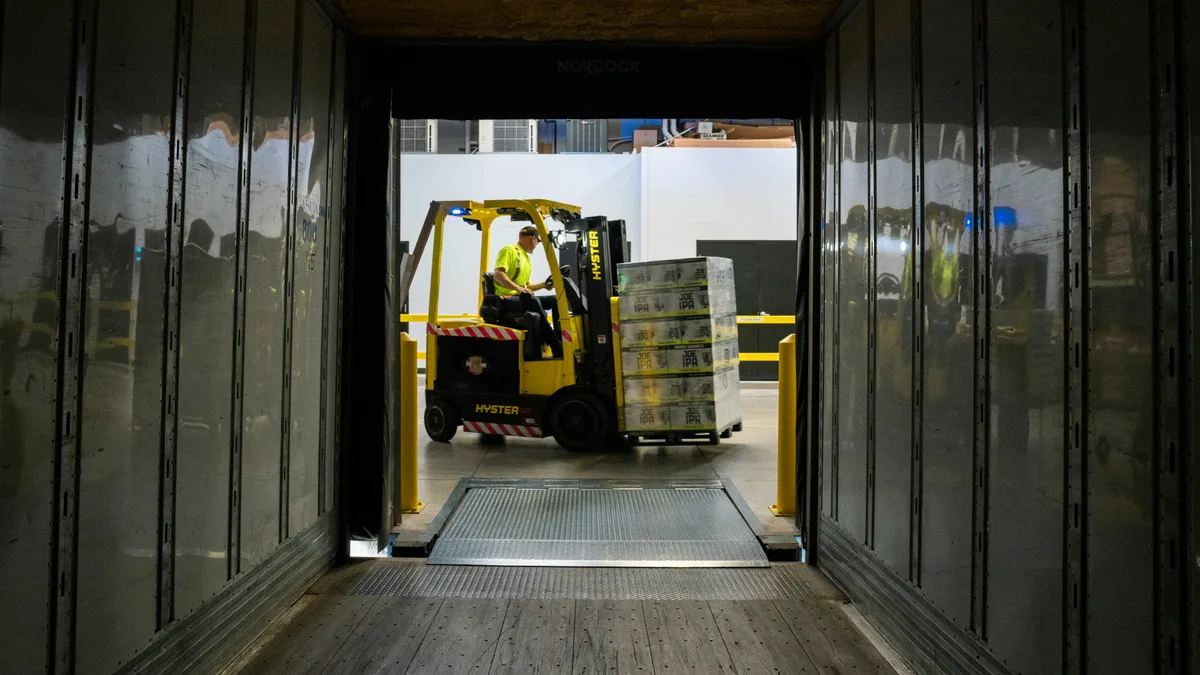
In almost every warehouse and every production environment, people and machines share the same space. A forklift drives down an aisle, a colleague walks to the packing table with a box, a lorry driver steps out to check his load. It happens all day long, without anything going wrong. Until one time it does go wrong. Collisions between forklifts and pedestrians are among the most serious incidents that occur in logistics, simply because a person always loses against a machine weighing several thousand kilos. In this article we look at why this is such a persistent risk and what you can do about it.
Why this is so dangerous
The biggest problem is that a forklift behaves very differently from what people intuitively expect. A forklift is heavy, even without a load, and as a result has a much longer braking distance than you'd think. It doesn't stop the way a bicycle or even a car stops. On top of that, the operator's view is often limited. A load on the forks blocks the view ahead, which sometimes forces the operator to drive in reverse just to be able to see. Racking, corners and other trucks create blind spots where a pedestrian can suddenly appear.
And then there's the human factor. Pedestrians underestimate the danger because they see the truck every day and have grown used to it. That familiarity is treacherous. Someone who has walked safely past a moving forklift a hundred times walks just a little too close the hundred-and-first time, at just the wrong moment. The operator, in turn, counts on colleagues paying attention. Both assumptions together are exactly the recipe for an incident.
Separation is the first and best solution
The most effective way to prevent collisions is simply to keep people and machines from ending up in the same place. Physical separation works best: separate walkways for pedestrians, screened off with fencing or barriers, and separate driving routes for the trucks. Where full separation isn't possible, clear floor markings, pedestrian crossings at fixed points, and zones where trucks aren't allowed all help.
The idea behind this is simple: the less a pedestrian and a forklift have to watch out for each other, the smaller the chance that something goes wrong. No solution is watertight, but every metre where people and machines are separated is a metre where a collision is impossible.
Visibility, speed and eye contact
Where separation isn't fully possible, it comes down to three things. First, visibility. Mirrors at blind corners, good lighting and keeping sightlines clear help both the operator and the pedestrian to see each other in time. Second, speed. A forklift driving at walking pace in places where pedestrians may be has a much shorter braking distance and gives both parties more time to react. Third, eye contact. One of the simplest and most powerful habits an operator can develop is to briefly seek eye contact at a junction or with a pedestrian. Seeing and being seen prevents more accidents than any sign ever could.
Communication makes the difference
Many incidents arise from misunderstandings. The pedestrian thinks the operator has seen them, the operator thinks the pedestrian will wait. Good communication takes that uncertainty away. Clear agreements about who has right of way, using the horn at intersections, and a culture of speaking up when something isn't safe are at least as important as the physical measures. Safety on a shared floor isn't a matter of rules on paper, but of people looking out for one another and expecting the same in return.
It's a shared responsibility
It's tempting to place safety entirely on the forklift operator. After all, they're the one operating the machine. But in practice it only works if everyone takes part. The operator adjusts their speed and takes pedestrians into account. The pedestrian stays on the walkways, wears a hi-vis vest where needed and stays alert. And the employer provides a layout in which safe working is possible in the first place. Only when those three come together does a workplace emerge where people and machines function safely alongside each other.
What do you learn at HefPro?
At HefPro we train operators not only in operating the machine, but also in being mindful of their surroundings and the people in them. A good operator looks beyond their forks. They anticipate pedestrians, recognise the places where things can go wrong and adjust their behaviour accordingly. Because we train on-site, we do so in the participant's real working environment, with the real walking routes and junctions where it happens every day. That way safe working becomes not theory, but habit.
Want to know how we'd approach this for your team? Get in touch via info@hefpro.nl or +31 6 15 37 48 10. We're happy to think along with you.